
The Great Migration is the largest movement of land mammals on Earth - around 1.5 million wildebeest with zebra and gazelle in tow, chasing rain across the Serengeti ecosystem in a rolling circle of birth, pursuit and storm. This guide follows the herds month by month, and explains how to plan a Tanzania safari around where they will be.
What the Migration Home Actually Looks Like
Imagine a moving river of animals nearly 2,000 kilometres long, banked by predators that shadow it year-round. Wildebeest, zebra and eland graze the plains in a clockwise orbit of the greater Serengeti, driven by rainfall rather than a fixed calendar - which is why the map matters more than the date.
The migration is never in one place: on the same day herds may be calving in the south while the north waits for storms. Professional operators track movement daily so your camp and drives sit in the right third of the park for your week.
Serengeti migration numbers
Roughly 1.5 million wildebeest, 200,000 zebra and 300,000 Thomson gazelle form the core herd, moving through 25,000 km2 of ecosystem - a third of which they walk each year.
The Migration Calendar, Simplified
| Months | Region | The highlight |
|---|---|---|
| Dec - Mar | Southern plains (Ndutu) | Calving - thousands of newborns, big predator action |
| Apr - May | Western Serengeti | Plains empty out, green season movement west |
| Jun - Jul | Grumeti / western corridor | First dramatic river crossings |
| Aug - Oct | Northern Serengeti | Mara River crossings - the classic images |
| Nov - Dec | Returning south | Herds drift back as the short rains arrive |
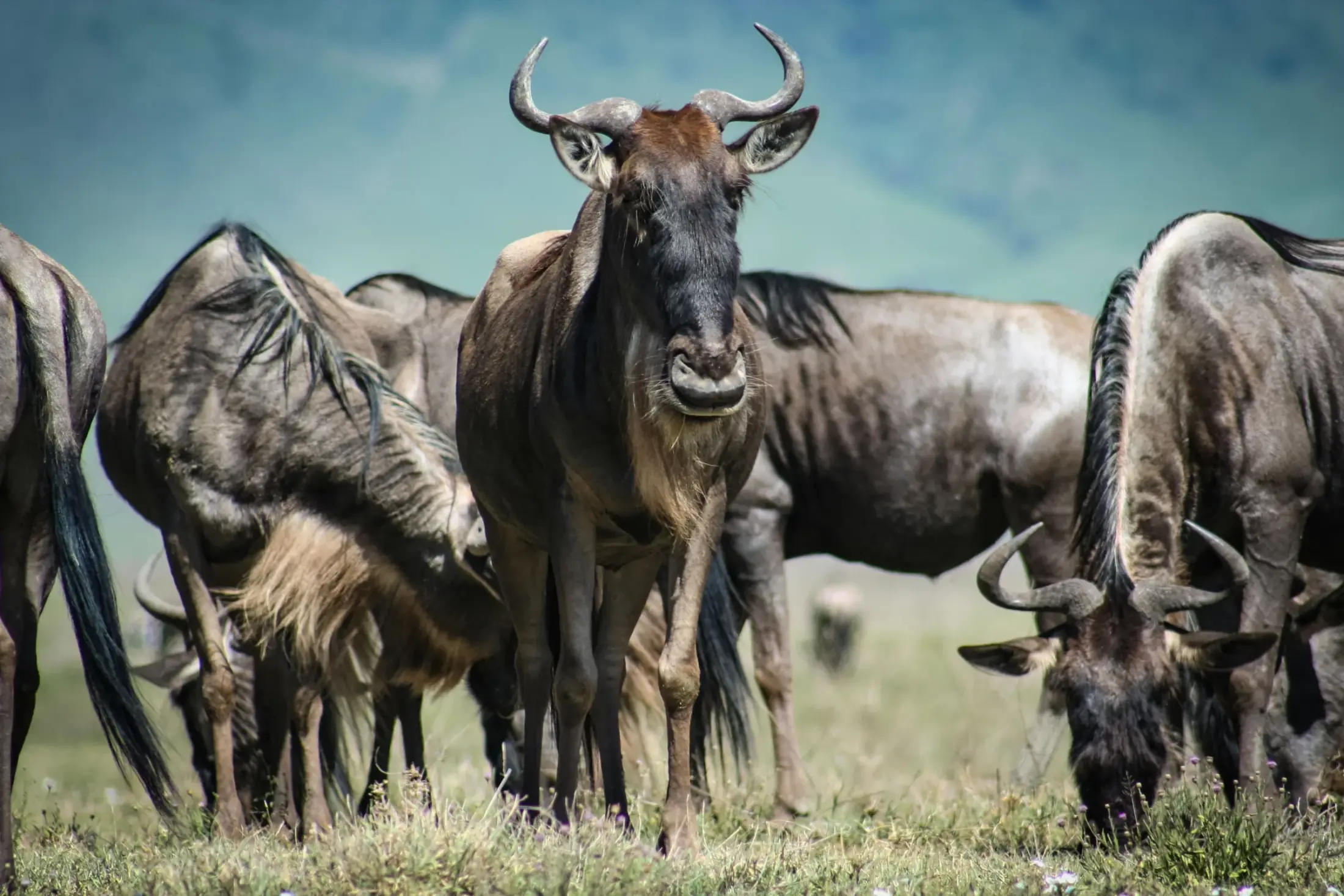
Calving Season: February on the Southern Plains
Between December and March the migration gathers on the short-grass plains of Ndutu, one of the Serengeti's most carpeted predator theatres. Calving peaks in February when as many as 8,000 wildebeest are born in a single day - and lion, cheetah and hyena take full advantage. It is the quietest, most intimate window of the migration in Tanzania.
Why we love February in Tanzania
February combines the calving spectacle with low-season crowds and J-series pricing - the best of the migration at a third of the high-season cost. Add the crater and you have a complete, extraordinary week on the road.
River Crossings: June to October
As the grass dies, the herds surge north to the Grumeti and Mara rivers. Crossings are thrilling, chaotic and unpredictable - herds hesitate for hours before a single wildebeest commits and the column pours in. There is no ticketing and no guarantee; a patient guide, a good hide spot and early mornings are the whole craft.
- June-July: Grumeti River crossings in the western Serengeti.
- August-October: Kogatende and the Mara River crossings in the far north.
- Best crossing odds: late dry-season mornings and afternoons near deep pools.
Planning Your Migration Safari
- Pick your dates first, then choose the camp location that matches the herd.
- Book 4+ months ahead for June-October; February fills slower.
- Give the Serengeti three nights minimum in a mobile or fixed camp on the herds.
- Add a crater day or Tarangire for guaranteed variety beyond the migration.
You cannot book the migration, only place yourself in its path - and wait, delighted.
— Our migration specialist guide
Frequently Asked Questions
When is the best time to see the wildebeest migration?
February-March is the calving window on the southern Ndutu plains, when as many as 8,000 wildebeest are born in a single day and the predator action is at its peak. July-October is the crossing season in the far north, where the herds mass at the Grumeti and Mara rivers for the classic images you see in documentaries. Both windows come down to positioning: your operator tracks the herds daily and places your camp where the animals actually are during your week. February is also the quieter, lower-priced option, because high-season rates and crowds do not arrive until later in the year.
Are the river crossings guaranteed?
Never - no operator can guarantee a crossing, because the herds decide on the basis of weather, river depth and instinct rather than any schedule. Crossing behaviour typically involves hours of hesitation before a single wildebeest commits and the column pours into the water. Your odds improve sharply with time spent on the river and a guide who can read the herd, which is exactly why we schedule at least three migration nights rather than a single lucky drive-by. Even in the peak August-October weeks, the winning formula is patience, early mornings and a camp positioned close to the crossing points.
Can I see the great migration on a 5-day safari?
Yes, and the key is flying rather than driving to the Serengeti, which saves two full road days on each leg. A fly-in 3-night migration break lands you directly at a camp on the herds and gives real time on the savannah even inside a five-day window. With more days available, the classic circle adds Tarangire, with its elephant herds and baobabs, plus a Ngorongoro crater day for guaranteed big-game variety beyond the migration. For the best value, pair a short safari with February calving, when the spectacle is intense and flights and camps are cheaper.
Prefer to leave the planning to us?
Tell us your dates and interests — our local team will craft a free, tailor-made itinerary around this guide.
Plan My SafariKeep Reading
Tanzania Wildlife Guide
Lions, leopards, elephants and more - Tanzania's incredible mammals and the best parks for spotting each one.
Read guide
Tanzania's Big Five Guide
Where and when to find the Big Five - lion, leopard, elephant, buffalo and rhino - across Tanzania's parks.
Read guide
The Ultimate Tanzania Safari Guide
Everything you need to plan the trip of a lifetime - routes, seasons, budgets, packing and what to expect on the ground.
Read guide