
The best time for a Tanzania safari is not a single month — it is a set of windows, each showing the country at its best in a different way. Come in the long dry season for the most reliable wildlife viewing, in the short dry season for the calving herds, and in the green season for birds, newborn animals and softer prices.
Tanzania sits just south of the equator, so its seasons are driven by rain rather than by temperature. Broadly there are four: a short dry season in January and February, the long rains from March to May, the long dry season from June to October, and the short rains in November and December. Each one changes what the animals do, how full the parks feel and what a safari costs.
This guide works through the seasons, then the months, then the places and interests — so you can match your dates to the trip you actually want. If your dates are already fixed, skip straight to the month-by-month table and the sections on birding, families and photography.
The Four Seasons, Explained
With the exception of the highlands around Ngorongoro and Kilimanjaro, Tanzania is warm all year. What changes is the rain, and the rain is what the wildlife responds to.
Short Dry Season: January – February
Warm, mostly dry days with the odd shower. This is the calving season on the southern Serengeti plains, where hundreds of thousands of wildebeest give birth within a few short weeks. The concentration of newborn prey draws lions, cheetah and hyena, making it one of the finest times of year for predators. It is also a lovely window for the Ngorongoro Crater and Tarangire.
Long Rains: March – May
The heaviest rain falls from March into May, usually as afternoon and overnight showers rather than a constant downpour. Parks turn lush, rivers fill, and visitor numbers drop sharply. Prices fall with them. Roads in remote areas can become difficult, so this is a season for flexible travellers who value solitude and green landscapes over guaranteed dry weather.
Long Dry Season: June – October
The main dry season is the most popular time to travel, and for good reason. Vegetation thins, animals gather around water, and the bush is at its most visible. It is peak season for the Great Migration in the north and for general game viewing across the country. Expect cool mornings, warm days, and the highest prices and busiest camps of the year.
Short Rains: November – December
Short afternoon showers return in November and December, turning the plains green again. This is a quiet, handsome window: good light, fewer vehicles and a flush of resident and migratory birds. Resident wildlife remains excellent, and the migration begins to drift back south onto the Serengeti plains.
Rain rarely means a washed-out day
Green-season rain in Tanzania is usually intense but brief, often overnight or in the late afternoon. Mornings are frequently clear, and the light after rain is some of the best you will ever photograph.
Month-by-Month Guide
Use the table below as a starting point. Wildlife is predictable in its patterns but never its exact timing, so read every line as a tendency rather than a guarantee.
| Month | Weather | Wildlife | Crowds | Best for |
|---|---|---|---|---|
| January | Warm, mostly dry | Calving begins on the southern plains | Moderate | Predators and newborn herds |
| February | Warm, occasional showers | Peak calving; big cats active | Moderate | Calving season, Ngorongoro Crater |
| March | Wetter, building rain | Herds drift north as rains arrive | Low | Green-season value |
| April | Long rains | Wildlife spread out; lush and quiet | Low | Lush landscapes and solitude |
| May | Rains easing, green | Rivers high; game dispersed | Low | Bargains and birding |
| June | Dry returns, cool | Migration pushes west and north | Rising | Early migration, good general viewing |
| July | Dry and cool | Grumeti crossings; strong predator action | High | Great Migration |
| August | Dry, hazy skies | Mara River crossings; peak drama | High | River crossings and big herds |
| September | Dry and warm | Northern Serengeti at its best | High | Migration and general game |
| October | Hot, dry and dusty | Herds begin heading south | Falling | Late migration, quieter parks |
| November | Short rains | Green flush; migration returns south | Low | Birds, value and space |
| December | Warm, with showers | Calving build-up; plains fill | Moderate | Festive family travel |
The shoulders are often the sweet spot
Late June and early July, or late October and early November, can give you dry-season wildlife with green-season crowds and prices. If your dates are flexible by even a week, aim just outside the peak.
The Great Migration Calendar
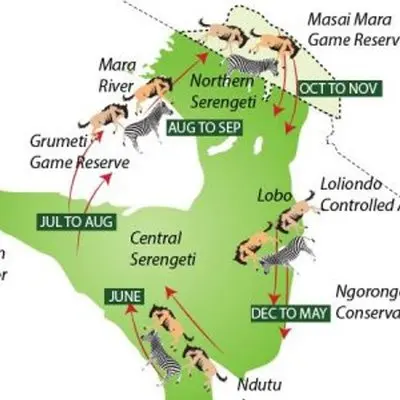
The Great Migration is a continuous, year-round movement of around 1.5 million wildebeest and hundreds of thousands of zebra and gazelle, following the rain and the grass across the Serengeti and Masai Mara ecosystem. It is not a single event, and it never runs exactly to schedule — the dates below are a reliable guide rather than a promise.
| Period | Where the herds are | What to look for |
|---|---|---|
| December – March | Southern Serengeti and the Ndutu area | Calving in February; predators close behind |
| April – May | Central and western Serengeti | Herds moving north as the long rains pass |
| June | Western Corridor and the Grumeti River | The first river crossings |
| July – August | Northern Serengeti and the Mara River | The famous river crossings |
| September – October | Northern Serengeti and Lamai | Large herds on the move toward Kenya |
| November | Central Serengeti and back south | Herds return as the short rains arrive |
Follow the camps, not the calendar
Because the herds move with the rain, the most reliable way to see a river crossing is to stay in a camp that moves with them. Tell us your dates and we will place you where the migration is most likely to be at that moment.
It is always a wild animal migration
No one can guarantee a river crossing on a given day. Some travellers wait three days and see several; others see none. Build extra time in the north and treat every crossing as a gift.
Best Time by Park
Different parks peak at different times. The dry season is a safe all-round choice, but the green season rewards travellers who know where to look.
| Park | Best months | Why |
|---|---|---|
| Serengeti | June – October | Thin bush and concentrated game; the migration |
| Ngorongoro Crater | June – October | Dry crater floor and strong Big Five sightings |
| Tarangire | July – October | Elephant herds gather at the river |
| Lake Manyara | June – October, and November – March | Game in the dry; flamingos and birds in the wet |
| Ruaha | June – October | Southern dry season with superb predator viewing |
| Nyerere (formerly Selous) | June – October | Boat safaris and water-based game viewing |
Travel in the green season and the southern and western parks come into their own. They are quieter, greener and often cheaper, while the north stays busy around the migration.
Best Time for Birding
Tanzania is one of the finest birding countries in Africa, with more than 1,100 recorded species. Birding is excellent all year, but the picture shifts with the seasons.
- Resident species — reliable year-round, and at their most visible in the dry season when the bush is thin.
- Palearctic migrants — arrive from Europe and Asia roughly November to April, swelling the lakes and wetlands with waders and waterbirds.
- Breeding plumage — many species moult into bright colours in the green season, from December to March.
- Water birds — Lake Manyara, Lake Natron and the northern lakes are superb in the wetter months.
Species found almost nowhere else
Tanzania holds a striking number of near-endemic birds, including forest species of the Eastern Arc Mountains such as the Udzungwa and Usambara ranges. A specialist birding guide transforms these trips.
Best Time for Families
Families tend to do best in the dry season, when vehicles can reach almost anywhere, malaria risk is lowest and animals are easy to find. The June to October school-holiday window is the obvious choice, though it is also the busiest and most expensive.
- July and August — the classic family safari: dry, reliable and full of wildlife, but in high demand.
- December and January — warm and pleasant, good for younger children during long school breaks.
- Shorter game drives — plan around younger attention spans, with snacks, entertainment and sun protection.
- Malaria precautions — fewer mosquitoes in the dry months, but repellent and prophylaxis still matter.
Consider a private vehicle for a family
A private 4x4 lets you set your own pace, stop when the children want to and build in rest days. It is the single biggest upgrade for a family safari.
Best Time for Photography
Photographers chase light, dust and drama, and each season offers a different version of all three.
- Long dry season (June – October) — thin vegetation, animals around water and golden, dusty light at dawn and dusk.
- Green season (November – May) — dramatic skies, saturated colour, newborn animals and clean air after rain.
- Calving season (February – March) — predator action and vulnerable young, though the grass is tall.
- Golden hour — whatever the month, the best light is the first and last hour of the day. Plan game drives around it.
Ask for a photographic vehicle
A private vehicle with space for tripods, camera rests and a pop-up roof gives you the angles and the patience a serious photographer needs. Just tell us when you book.
The Green-Season Advantage
The green season — broadly November to May — is often dismissed as the wrong time to travel. In truth it is one of the best-value and most beautiful windows in Tanzania, provided you accept the possibility of rain.
- Lower prices — many camps and lodges drop their rates, so the same trip costs noticeably less.
- Fewer crowds — popular parks feel private, and you rarely queue at a sighting.
- Lush landscapes and newborn animals — green plains, dramatic light and young life everywhere.
- Outstanding birding — migrants arrive and residents display their breeding plumage.
- Longer stays for less — savings can be reinvested in more nights or a higher standard of camp.

Remote roads and airstrips
During the long rains some remote tracks and bush airstrips can be affected. We plan green-season trips around regions and routes that stay reliable, and we keep itineraries flexible.
What to Pack by Season
Your kit should follow the season. The one constant is layers: safari mornings and evenings are cool, even when the midday sun is fierce.
| Season | Weather | Pack |
|---|---|---|
| Short dry (Jan – Feb) | Warm days, occasional showers | Light layers, sun hat, a light rain shell, sunscreen |
| Long rains (Mar – May) | Regular afternoon and night rain | Waterproof jacket, dry bags, quick-dry clothing, sturdy boots |
| Long dry (Jun – Oct) | Cool mornings, warm dry days | Warm fleece and hat for dawn drives, dust protection for gear |
| Short rains (Nov – Dec) | Warm with afternoon showers | Rain shell, light layers, insect repellent, binoculars |
Whatever the season, pack neutral colours for game drives and leave bright blue and black at home, as tsetse flies are drawn to them.
Balancing Crowds, Cost and Wildlife
There is no perfect month — only a trade-off between dry weather, animal concentrations, price and how many vehicles share a sighting. Decide which of those matters most to you, and the season chooses itself.
If you value reliable animals above all, travel June to October and accept the crowds. If you value space and price, travel November to May and accept the showers. If you want predators and newborns, travel January to March.
There is no wrong month for a Tanzania safari — only a month that suits one trip better than another. Tell us what matters most and we will point you at the right fortnight.
Notes from our team in Moshi
Frequently asked questions
What is the best month for a Tanzania safari?
For the most reliable wildlife viewing and dry weather, July to September is the safest all-round choice. Vegetation is thin, animals gather around the remaining water, and the days are warm and largely rain-free. If you want those same good conditions with lower prices and quieter parks, late June and early July, or late October and November, are excellent shoulder-season alternatives. If predators and newborn animals matter most to you, aim for the calving season in January and February. There is no single best month for everyone — it depends on what you want to see and how much you mind the crowds and the cost of peak-season travel. Tell us your priorities and we will point you towards the right fortnight.
Is the rainy season a bad time to visit Tanzania?
Not at all. The green season brings lush scenery, newborn animals, superb birding and significantly lower prices, with far fewer visitors sharing the parks. Rain usually falls as short, heavy showers — often overnight or in the late afternoon — rather than all-day drizzle, so mornings are frequently clear and the light afterwards is beautiful for photography. Wildlife remains abundant, with strong predator viewing and excellent resident birdlife, and the crowds simply melt away. The main caveat is that some remote roads and bush airstrips can be affected during the long rains of April and May, so a little flexibility helps. We plan green-season trips around regions that stay reliable, and many travellers find it their favourite, most private time of year.
When is the best time to see the Great Migration?
The migration is a year-round cycle rather than a single event, so the answer depends on what you want to see. Calving happens on the southern Serengeti plains around January to March, when hundreds of thousands of wildebeest give birth and predators gather close behind. The herds then move north and west, reaching the Grumeti River area in roughly June, where the first river crossings often take place. The famous Mara River crossings in the northern Serengeti are typically July to September, and by November the herds are drifting back south with the short rains. Because the animals follow the rain, the most reliable approach is to stay in a camp that moves with them — tell us your dates and we will place you where the herds are most likely to be.
When is the best time to see the Big Five?
The dry season, roughly June to October, is the best time. Vegetation thins out, animals concentrate around the remaining water sources, and sightings become easier across the board. The Ngorongoro Crater offers one of the most reliable chances in Africa of seeing rare black rhino, while the Serengeti delivers outstanding lion and leopard viewing. Lion, elephant and buffalo are seen year-round, but leopard sightings in particular improve when the bush thins and the cats are forced to rest in more visible trees. The green season from January to March is also excellent for predators, though the grass is taller and spotting can be harder. Combining the Serengeti, Ngorongoro and Tarangire on one private itinerary gives you the highest chance of completing the set.
When is the best time for birdwatching?
Birding is good all year in Tanzania, but it peaks in the green season. Resident species are easiest to see in the dry months, when thin vegetation makes them simpler to find. Migratory species arrive from Europe and Asia roughly November to April, swelling the lakes and wetlands with waders and waterbirds. From December to March, many residents moult into bright breeding plumage, so the colours and displays are at their finest. Lake Manyara, Lake Natron and the northern lakes are especially rewarding in the wetter months. If you are a serious birder, a specialist guide transforms the experience — Tanzania holds more than 1,100 recorded species, including near-endemic forest birds of the Eastern Arc Mountains such as the Udzungwa and Usambara ranges.
When is the cheapest time to go on safari in Tanzania?
The long rains of March to May offer the lowest prices of the year, followed closely by the short rains of November. Rates rise steadily through the dry season and peak from July to September, when demand for the migration is at its highest. Green-season travel can cost meaningfully less for the same itinerary, and the savings often stretch to extra nights or a higher standard of camp. Beyond timing, your choice of accommodation and how many people share a vehicle matter enormously — simple lodges, public campsites and group-joining departures all lower the per-person cost. We are a local operator based in Moshi, so there is no middleman adding commission. Tell us your budget and we will show you exactly what it can achieve.
Can I see the migration without travelling in peak season?
Yes, and many travellers prefer it. The herds are on the move for twelve months of the year, and outside the northern peak of July to September they gather in the southern and central Serengeti. In February the calving season draws vast concentrations of wildebeest onto the southern plains, with big cats never far behind, yet far fewer vehicles share the spectacle. November offers another beautiful window, as the herds drift back south with the short rains and the plains turn green. Both months bring lower prices, quieter camps and softer light. You will not usually see a dramatic Mara River crossing, but you will see the migration as a living, moving force — often with a sighting all to yourself.
Is it too hot for a safari in January?
No. January and February are warm but rarely oppressive, and much of the country sits at altitude, which keeps the heat gentle. It is also the calving season, which many guides consider the best time of year for predators, as lions, cheetah and hyena follow the newborn herds on the southern Serengeti plains. Early-morning game drives are cool almost everywhere, so layers are essential, and the highlands around Ngorongoro and Kilimanjaro stay mild even in midsummer. Expect the odd afternoon shower, but it rarely disrupts a day. If you would rather avoid heat altogether, the dry-season months of June to August bring cooler mornings. Either way, the wildlife is the reward — just pace your days and drink plenty of water.
Related safaris & guides

Ready to start planning?
Tell us your dates, group size and travel style. We will design a private Tanzania safari around you and send a full quote — free, with no obligation.