
Overview of the Northern Circuit route
The Northern Circuit is the longest route up Kilimanjaro and, by most measures, the most successful. It begins like Lemosho on the western slope, crossing the Shira Plateau – but instead of turning south at Lava Tower it sweeps north around the back of Kibo, traversing the remote northern face past Mawenzi for three quiet days that no other route sees, before rejoining the southern circuit at Barafu for summit night.
Nine days on the mountain buys the thing that matters most: time above 3,000 m. Roughly 90% of climbers who walk the Northern Circuit reach Uhuru Peak, the highest published rate of any route, and the walking is gentler than the southern approaches – long, steady days rather than steep ones. The trail is also the quietest on the mountain: for three days you may not meet another climbing party at all.
Safety first: To maintain our strict safety standards, mountain expeditions are available only to participants aged 12–70 years.


Expert recommendation
If you have nine days, this is the climb. The Northern Circuit gives you the best summit odds on the mountain and the most solitude, and the gentle profile makes it one of the more comfortable ways to do it. It costs more than Lemosho – three extra days of park fees – and for most climbers that is the best money spent on the whole trip.
The photographer’s and perfectionist’s route
The north-face section – the glaciers of Kibo on one side, the needle of Mawenzi on the other, with no one else in sight – is the finest sustained scenery on Kilimanjaro that most climbers never see. If the summit is a given rather than a gamble for you, this is the route that delivers the mountain itself.
Northern Circuit on the Kilimanjaro map
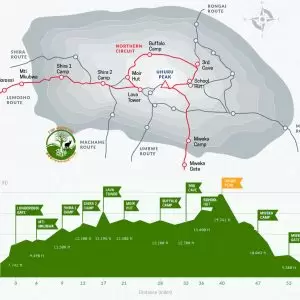
The Northern Circuit starts at Londorossi Gate and climbs the western slope exactly as Lemosho does, through rainforest to the Shira Plateau. At Shira Camp 2 the route turns north instead of east, crossing the high western plateau to Moir Hut, then traversing the remote north face past Buffalo Camp and Third Cave – below the glaciers of Kibo and opposite Mawenzi – to School Hut at 4,700 m. From School Hut it is the same summit night as every other route, with the descent made by the Mweka route.
Join our Kilimanjaro Group Climbs
You do not need a private climb to walk the Northern Circuit. We run fixed group departures throughout the year on which six to ten climbers start together, sharing the guide, the crew and the camp – and paying the shared-group rate shown on each departure below. Most of our solo travellers join one.
Group Northern Circuit departures typically run monthly, scheduled around the dry windows – June to October and mid-December to March – and because it is a nine-day climb, we build the Moshi arrival and departure days around each group. Pick a year and a month below to see what is running; a $100 deposit holds a place, and if no departure suits your dates we will build the same itinerary as a private climb instead.
Arrival 02 Sep 2028
Departure 09 Sep 2028
From $2,150 per person
Join group tourArrival 06 Sep 2028
Departure 13 Sep 2028
From $2,150 per person
Join group tourArrival 10 Sep 2028
Departure 17 Sep 2028
From $2,150 per person
Join group tourArrival 14 Sep 2028
Departure 21 Sep 2028
From $2,150 per person
Join group tourArrival 18 Sep 2028
Departure 25 Sep 2028
From $2,150 per person
Join group tourArrival 22 Sep 2028
Departure 29 Sep 2028
From $2,150 per person
Join group tourArrival 26 Sep 2028
Departure 03 Oct 2028
From $2,150 per person
Join group tourNorthern Circuit - Summit Success Rate
The Northern Circuit publishes the highest summit rate on Kilimanjaro – around 90%, against a mountain-wide average near 65% and 85–90% for the eight-day Lemosho. There is nothing magical in it: nine days means more nights above 3,000 m, more meals, more sleep and a body that has had a full week to build the red blood cells that altitude demands.
The gentle north-face walking helps too. Because no day is steep, climbers arrive at camp after nine days less beaten up than on the southern routes, and the acclimatisation day at Moir Camp is a genuine rest rather than a hard walk. It is the closest thing Kilimanjaro offers to a comfortable route to the summit.
What the number really means
A success rate counts climbers who reach Uhuru Peak. It never counts the wisdom of a guide who turns a group around at 4,700 m – and that decision is still a good climb. See how we measure summit success for the full picture.
Northern Circuit Detailed Itinerary
The nine-day Northern Circuit itinerary, as we guide it – the longest standard itinerary on the mountain, with a full acclimatization day built in at Moir Hut. Every day is walked slowly, with a hot lunch at camp and breakfast in bed where the schedule allows.
A single nine-day itinerary – the longest we run, and the one that posts the highest summit rate.
-
Moshi to Mti Mkubwa Camp via Lemosho Gate
An hour in a vehicle from Moshi takes you around the mountain to Lemosho Gate on the quiet western slope, where permits are checked and the porters load their kits. From the gate the path climbs through coffee shambas and into rainforest – the wettest, greenest and liveliest zone on the mountain, home to colobus monkeys and hornbills – to Mti Mkubwa Camp, the Forest Camp, at 2,820 m. The first day is deliberately short: three to four hours, ending with tea in the mess tent.
Lunch offered: Hot lunch at Lemosho Gate after the transfer
-
Mti Mkubwa Camp to Shira Camp 1
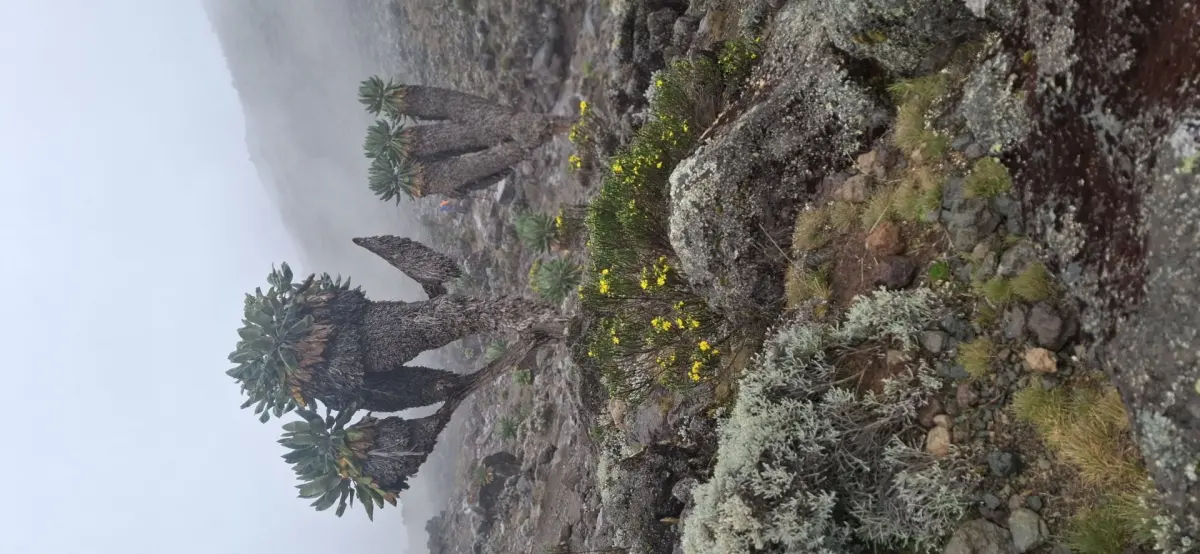
The rainforest thins into heath and the odd giant groundsell as the trail opens onto the Shira Plateau, one of the highest plateaus on earth. The walking is steady and unhurried across the moorland, with the glaciers of Kibo appearing above the ridge to the east. Camp is at Shira Camp 1 at 3,500 m, and it is rare to see another group up here.
Lunch offered: Hot lunch at Shira Camp 1
-
Shira Camp 1 to Moir Hut
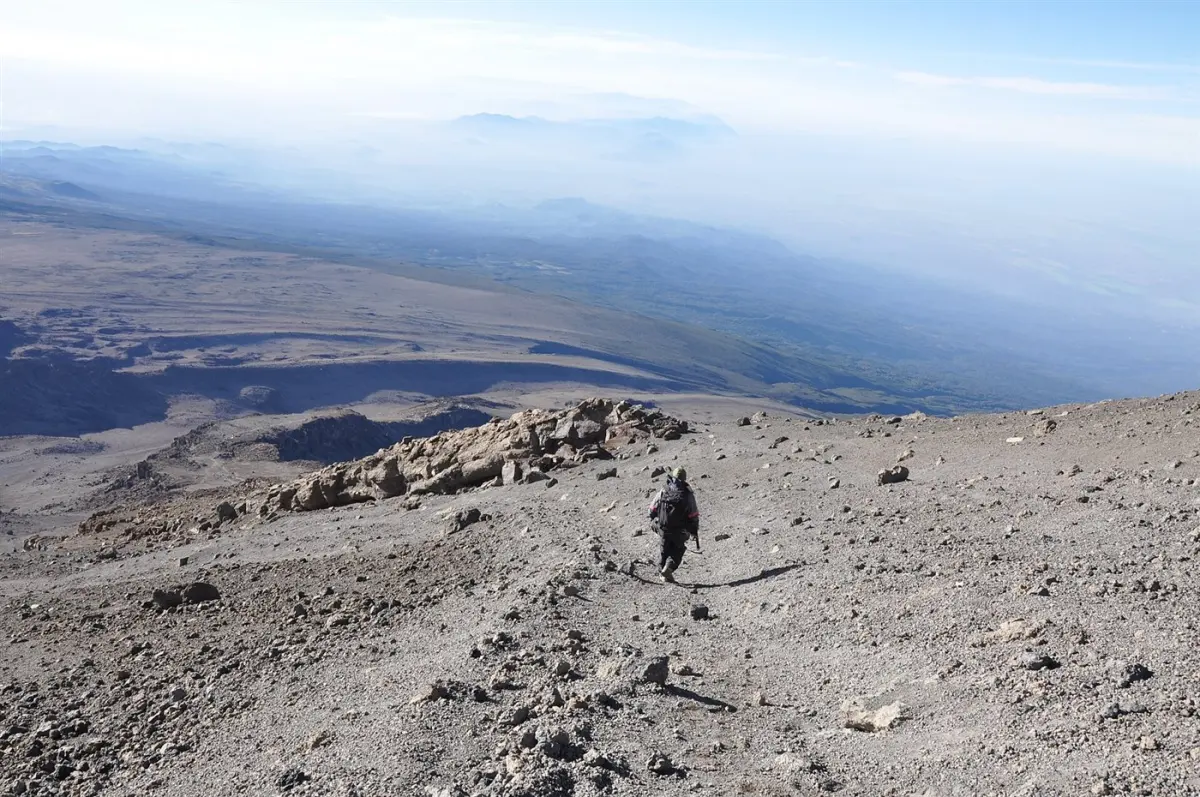
The trail leaves the main plateau and climbs north-west into the wilder upper reaches of the mountain, over heath and lava rubble to Moir Hut at 4,150 m in a sheltered basin below the Lent Hills. This is where the Northern Circuit parts company with the crowds – for the next two days you may not see another group at all. Five to six hours, arriving into the quietest camp on the mountain.
Lunch offered: Hot lunch at Moir Hut
-
Acclimatization day above Moir Hut
A genuine rest day rather than a hard walk: after breakfast you climb the slopes above camp toward the Lent Hills and come back down to the same tent. The day exists purely to spend another night at 4,150 m with movement above it – the pattern that gives the nine-day itinerary its summit rate – and the afternoon has nothing in it but reading, sleeping and watching the weather build over Kibo.
Lunch offered: Hot lunch at Moir Hut
-
Moir Hut to Buffalo Camp
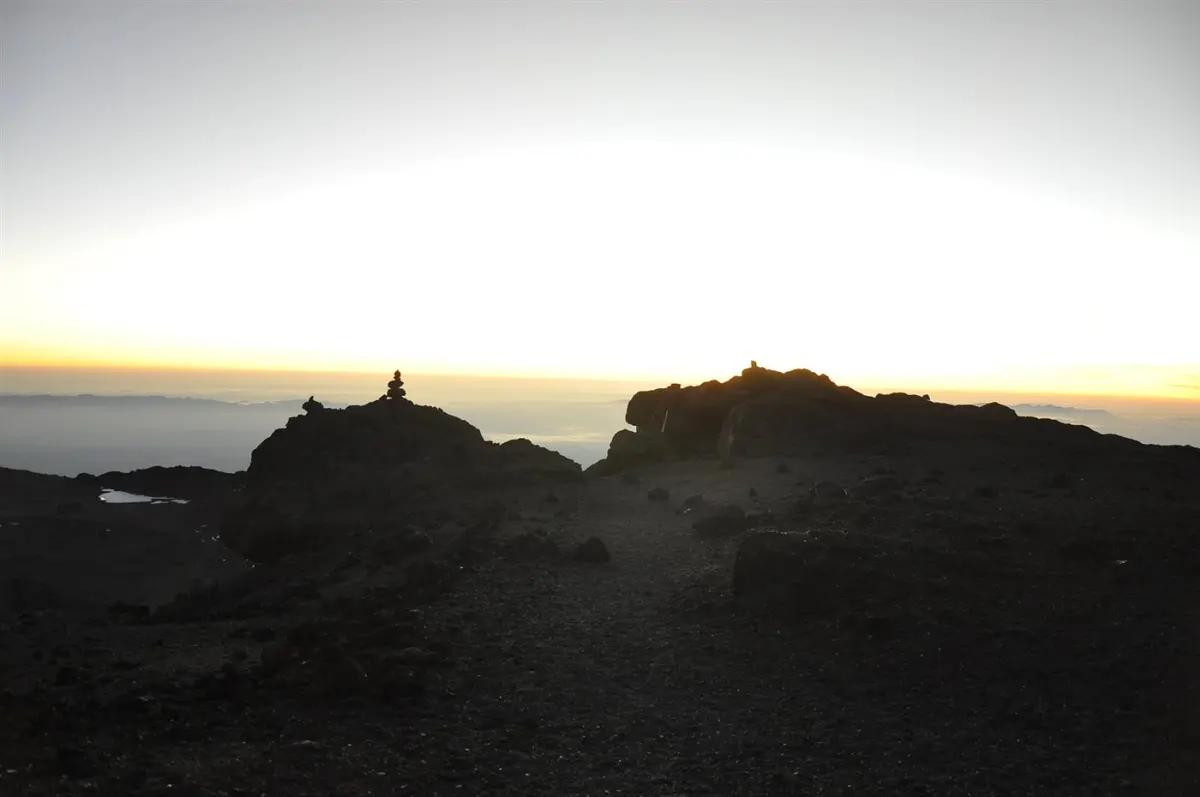
The first of the three north-face days, and the finest sustained scenery on Kilimanjaro that most climbers never see: Kibo’s glaciers wall one side of the trail, the needle of Mawenzi rises across the saddle on the other, and the path undulates gently below them. Buffalo Camp at 4,050 m is a scatter of pitches on open ground – one of the smallest camps on the mountain, shared most nights with no one at all.
Lunch offered: Hot lunch at Buffalo Camp
-
Buffalo Camp to Third Cave
The traverse continues east below the north face, dropping slowly through alpine desert to Third Cave at 3,870 m – a marked spot with a single toilet tent and space for a handful of groups. The gradual profile is the point: the itinerary gives height back almost as carefully as it takes it, so the body keeps adapting without ever being hammered. Five to six hours on easy ground.
Lunch offered: Hot lunch at Third Cave
-
Third Cave to School Hut
The trail swings up the Kibo side of the saddle, leaving the north face behind and climbing to School Hut at 4,700 m – the staging post for the summit, on bare ground under the Reusch Glacier. Four to five hours, with the afternoon spent exactly like every evening before a summit night: soup, layers sorted, an oxygen check with the guide, dinner and bed while it is still light.
Lunch offered: Hot lunch at School Hut

-
Summit day: School Hut to Uhuru Peak to Mweka Camp
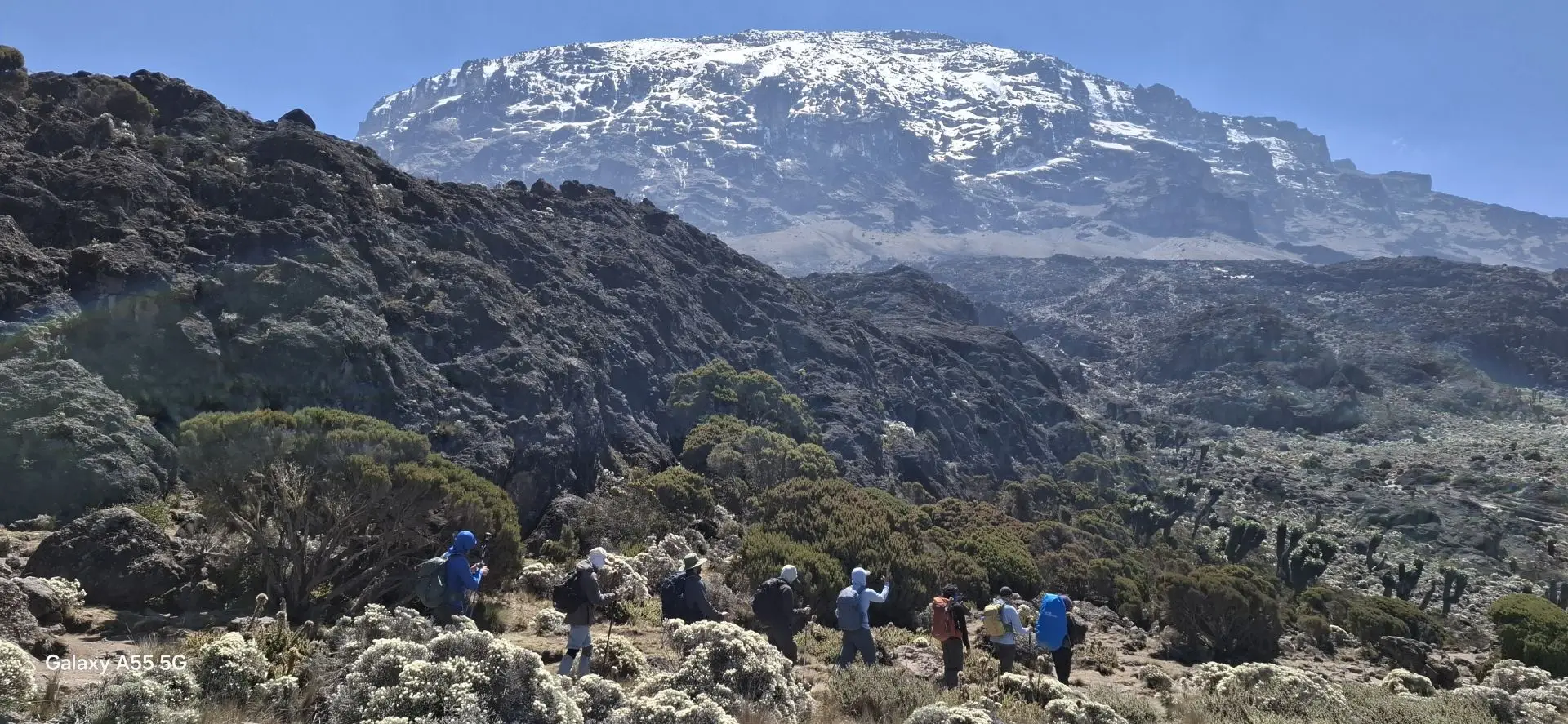
Shortly after midnight School Hut empties, and the line of headtorches moves up the scree in the dark – six to seven hours to Stella Point on the crater rim as the sky lightens, then an hour on to Uhuru Peak at 5,895 m as the sun comes up over the plains. Photographs, a short rest and a drink at the sign, then the long descent all the way to Mweka Camp at 3,100 m – the same compressed descent every route shares, starting from School Hut rather than Barafu.
Lunch offered: Hot lunch at Mweka Camp after the descent
-
Mweka Camp to Mweka Gate
A relaxed three-hour walk down through the rainforest to Mweka Gate, where the mountain authority signs off your summit certificate and the crew sings. From here it is back to the hotel in Moshi for showers, a cold drink and the celebration dinner. After nine days, the end of the trek feels like the start of the stories.
Lunch offered: Farewell lunch at Mweka Gate

Summit night is the real test
Expect -10°C to -15°C, six to seven hours in the dark and very little sleep beforehand. With correct layers, steady pacing and your guide watching your oxygen levels, it is well within reach of any prepared hill walker. See our Kilimanjaro packing list before you fly.
Prices for the Northern Circuit
The Northern Circuit is the most expensive of the standard climbs, and the reason is honest arithmetic: park fees – entry, camping and rescue – are charged per climber per day, and there are nine of them. Everything below is per person in US dollars and includes the two hotel nights in Moshi, all transfers, all meals on the mountain and the full crew.
The full matrix, by group size:
| Group size | 9-day climb |
|---|---|
| 1 traveller | $2,950 |
| 2 travellers | $2,455 |
| 3 travellers | $2,260 |
| 4 travellers | $2,140 |
| 5 travellers | $2,070 |
| 6 travellers | $2,015 |
| 7 travellers | $1,960 |
| 8 travellers | $1,905 |
| 9 travellers | $1,850 |
| 10 travellers | $1,805 |
| 10+ travellers | Ask us |
What is included in a Northern Circuit climb
- All Kilimanjaro National Park entry, camping and rescue fees
- Licensed English-speaking guide, assistant guides, cook and porters
- All meals, drinking water, tea and coffee on the mountain
- Sleeping tents, dining tent, mattress and camp furniture
- Two hotel nights in Moshi before and after the climb
- Airport and trailhead transfers from Moshi or Arusha
- Emergency oxygen, pulse oximeter and a comprehensive first-aid kit
- Daily health and altitude monitoring by your guide
- Summit certificate and applicable government taxes
What is not included
- International and domestic flights
- Tanzania visa fees
- Travel and high-altitude trekking insurance
- Personal gear rental (sleeping bag, poles, boots, jackets)
- Tips and gratuities for guides, porters and cook
- Alcoholic and soft drinks, and snacks
- Additional hotel nights and personal expenses
See every route and group size side by side – or save the full Kilimanjaro price sheet as a PDF.
What to Expect on the Northern Circuit
Start like Lemosho, then go north
The Northern Circuit starts the same as Lemosho: rainforest to Mti Mkubwa Camp, then onto the Shira Plateau. Where Lemosho turns south, it turns north and circles Kilimanjaro. Those first two days – quiet, open and scenic – are among the best of any route.
Days of solitude and big views
The middle stretch on the north face is the least used part of Kilimanjaro. You may walk for days without meeting another group. Kibo looks completely different from the back – glaciers, crater and saddle in a view most climbers never forget. The profile is long and steady rather than steep – the gentlest sustained gradient of any Kilimanjaro route.
Nine days trades patience for success
Nine days means more park fees, more nights in a tent and real camp-life patience – the trade for the highest summit success rates among the popular routes. It’s not technically hard, but it does ask for endurance, mental resilience and a commitment to the slow pace. The acclimatisation is superb.
Summit night and descent
Summit night from School Hut: midnight start across the scree to Stella Point (5–6 hours), then Uhuru Peak (5,895 m) for sunrise. After photos, you descend the Mweka route through moorland and rainforest to Mweka Gate with your summit certificate – exhausted, but elated.
Preparation Tips
Nothing on the Northern Circuit is technical – the gentle gradients make it one of the physically easier routes. What nine days asks for is endurance, camp-life patience and honest preparation in the months before you fly.
- Train for endurance, not speed. Hill walks, stairs and back-to-back weekend hikes with a loaded pack, eight to twelve weeks out – see our Kilimanjaro training guide for a week-by-week plan.
- Break in your boots properly and train in the exact socks and daypack you will climb in.
- Pack from the Kilimanjaro packing list and add for nine days: more book or podcast material, spare laces, and extra blister kit than you would pack for a shorter climb.
- Arrive a day early. The briefing, the equipment check and one night of altitude-free sleep in Moshi are worth more than an extra day at home.
- Book three to six months ahead for the dry seasons – June to October and mid-December to March – because nine-day permit blocks and crews are limited.
- Take out insurance that explicitly covers trekking to 6,000 m and emergency helicopter evacuation.
Why Choose Topi Adventure
Based at the mountain
We are a Moshi operator. Your guides live at the foot of Kilimanjaro, walk these trails every month and know exactly when to push and when to hold.
Safety without shortcuts
Emergency oxygen, a pulse oximeter and a full first-aid kit on every climb, twice-daily health checks, and guides trained to turn around when the data says so.
Small groups, real pace
We cap our groups and keep the pole-pole pace even when it feels slow – the pace is what summits people.
Honest, all-in pricing
Park fees, crew, meals, tents, hotel nights and transfers in the first line of the quote, not buried in the last. Two hotel nights in Moshi included.
Other routes on Mt. Kilimanjaro
The Northern Circuit is the longest of seven ways up Kilimanjaro, and nine days is not always available. These are the other six, each with its own full guide.
Lemosho Route
Rainforest, moorland and a high success rate on a quiet western approach. Our pick for most first-time climbers.

Machame Route
The classic “Whiskey” route: rainforest, moorland and the dramatic Barranco Wall.
Marangu Route
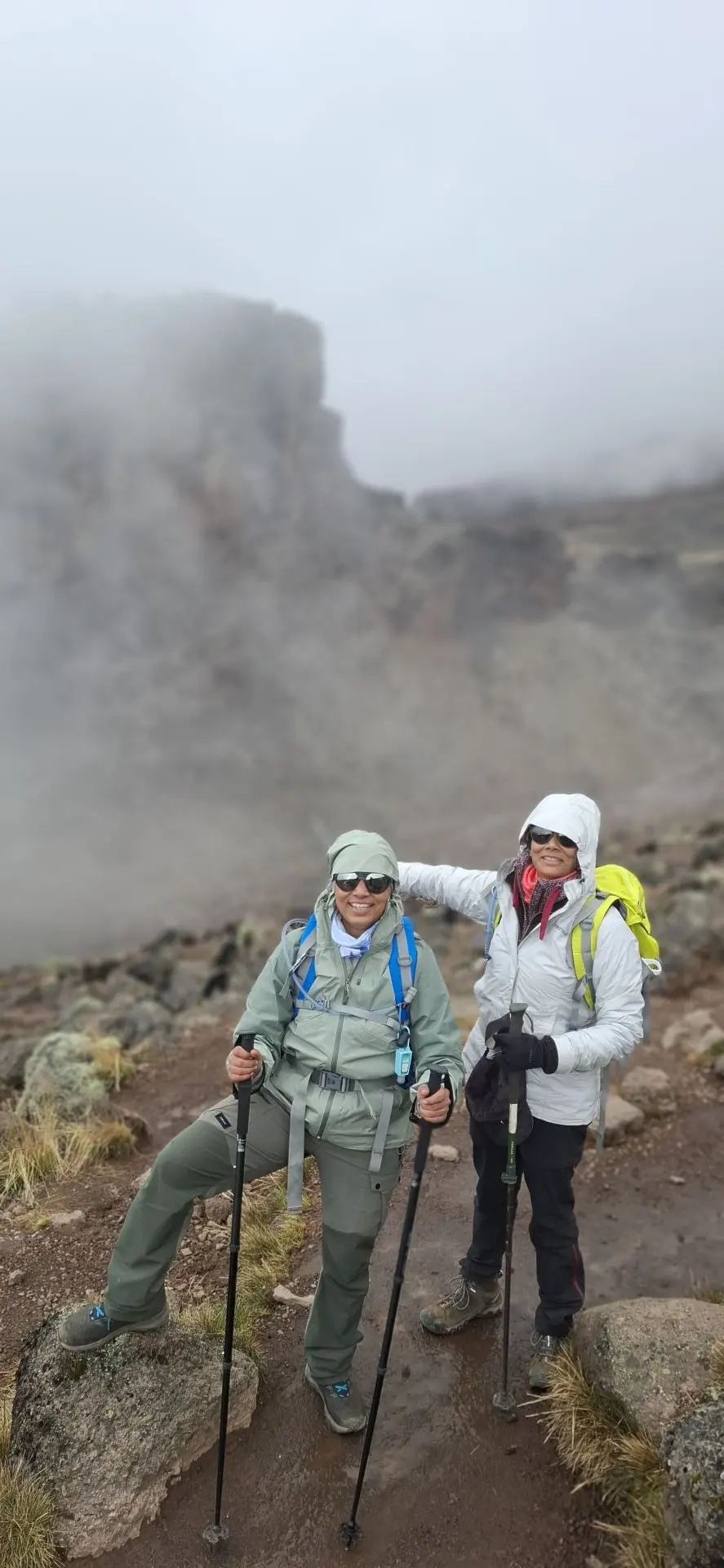
The only route with huts all the way up: fastest and cheapest, but the shortest time on the mountain costs success.
Rongai Route
The dry northern approach with gentle gradients – the strongest pick for the rainy season.
Umbwe Route
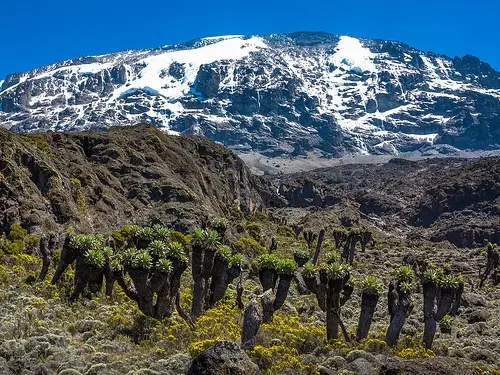
The steepest, most direct line up the mountain. Reserve it for experienced altitude trekkers.
Shira Route
Shares Lemosho’s western approach but starts higher and shorter. Quiet, scenic and usually merged with Lemosho.
Frequently asked questions
Is the Northern Circuit the best route on Kilimanjaro?
It has the highest summit rate – around 90% – and the quietest walking on the mountain, and nine days make it one of the most comfortable ways up. The only reason to choose something else is time or budget: it is the most expensive standard climb, and it needs ten days in Tanzania including travel.
How many days is the Northern Circuit?
Nine days on the mountain, including a full acclimatisation day at Moir Camp – so plan ten to twelve days in Tanzania once arrival, briefing and departure are counted. There is no shorter official version, and the length is exactly what produces the summit rate.
How hard is the Northern Circuit?
Physically it is one of the gentler routes: long, steady days with no steep or technical sections anywhere on the trail. The demands are the altitude, nine consecutive days in a tent and a twelve- to fifteen-hour summit day at the end. Reasonable hill fitness is genuinely enough.
What is the success rate on the Northern Circuit?
Around 90%, the highest published rate of any Kilimanjaro route, against a mountain-wide average near 65%. The nine-day schedule gives the body more nights above 3,000 m than any other itinerary, and time at altitude is what drives summit success.
How much does the Northern Circuit cost?
From $1,805 per person in a group of ten. It is the most expensive standard climb because park fees are charged per climber per day and there are nine days of them – park fees, crew, meals, tents, two hotel nights in Moshi and all transfers are included; international flights, visa, insurance and crew tips are not.
Northern Circuit or Lemosho – which should I choose?
Choose the Northern Circuit if you have nine days and the budget: it adds a rest day, three days of the quietest walking on the mountain and a few percentage points of summit rate over the 8-day Lemosho. Choose Lemosho if your time is tighter – it walks the same western approach and shares the southern finish, for less money and two fewer days.
Ready to talk it through with a local guide?
Tell us your dates, experience level and budget. We will recommend a route, build the day-by-day plan and send it back free, with no obligation.